
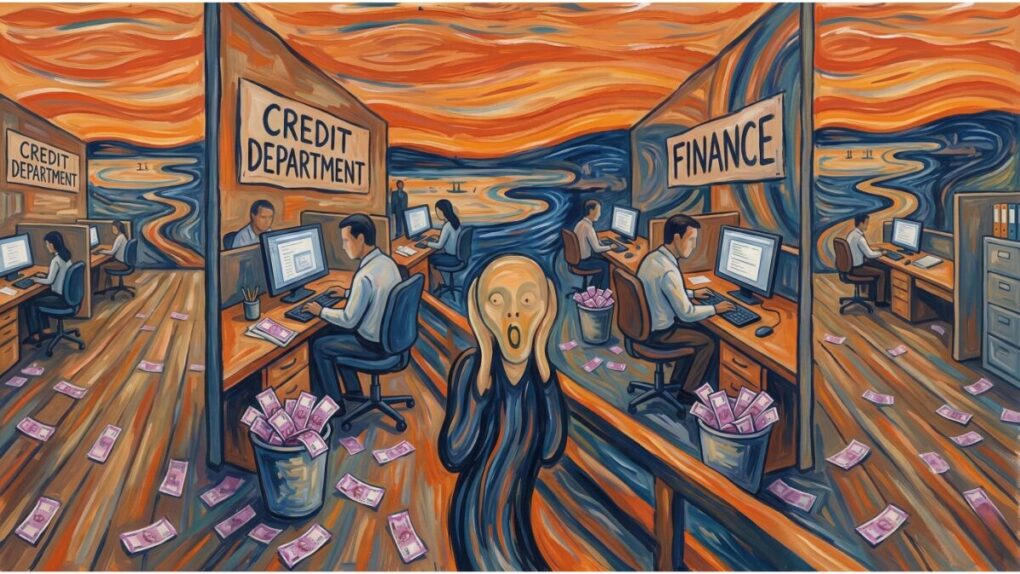
Credit leakage is the silent killer of profitability in Indian B2B distribution. It is not dramatic — there is no single large event that triggers alarm. Instead, it is a steady, quiet erosion: a dealer exceeds their credit limit by ₹2 Lakhs and nobody notices for three weeks. A payment deadline passes and the follow-up happens ten days late. A salesperson approves an order for a dealer who is already overdue because the salesperson does not have real-time visibility into the dealer's account.
Multiply this across hundreds of dealers and you have a working capital problem that consumes crores annually. I have seen businesses where credit leakage — the gap between what their credit policy says and what actually happens — accounts for 8–12% of their total outstanding at any given time.
The Manual System Problem
In most Indian distribution businesses, credit management works like this. Each dealer has a credit limit set by the finance team. The limit is recorded in the ERP. When a dealer places an order, someone — a salesperson, a billing clerk, or an order processing team — is supposed to check whether the dealer has sufficient credit available before confirming the order.
In practice, this check is inconsistent. During peak periods, orders are processed without credit verification. Salespeople, under pressure to meet targets, approve orders for dealers who are technically over-limit. The ERP shows the credit position, but the salesperson is taking orders on WhatsApp and does not check the ERP for every order. By the time the finance team reviews the outstanding, the goods are shipped and the leverage is gone.
The collection process compounds the problem. Payment follow-up is typically a manual process — phone calls, messages, and in some cases physical visits. The frequency and intensity of follow-up depends on the relationship between the salesperson and the dealer, not on the size or age of the outstanding. High-value overdue accounts sometimes get less follow-up than low-value ones simply because the salesperson does not want to damage a relationship.
What Real-Time Credit Visibility Changes
A digital commerce platform with integrated credit management changes this dynamic fundamentally. When a dealer logs into the platform, they see their current credit limit, their current outstanding, and their available credit — in real-time. When they add items to their cart, the system automatically checks whether the order fits within their available credit. If it does not, the order is blocked or flagged for manual approval.
This is not a feature. It is a policy enforcement mechanism. The credit rules that exist in your ERP but are inconsistently applied by humans are now applied automatically by the system, consistently, every time, without exception.
The impact is immediate. Unauthorised credit exposure drops to near zero because the system does not allow it. The finance team no longer needs to chase salespeople for credit compliance. And dealers know their exact credit position at all times, which reduces disputes and collection friction.
Automated Credit Limit Enforcement
The enforcement layer has three components in a well-designed system.
Hard limits block orders that exceed the dealer's available credit. The dealer sees a clear message: "Your available credit is ₹X. This order requires ₹Y. Please reduce your order or clear outstanding payments to proceed." No human intervention needed. No ambiguity.
Soft limits allow orders within a defined buffer — typically 5–10% above the credit limit — but flag them for manual approval by the finance team. This provides flexibility for trusted dealers while maintaining oversight. The key difference from the manual process is that every exception is logged, timestamped, and attributed to the approver.
Dynamic adjustments automatically increase or decrease credit limits based on payment behaviour. Dealers who consistently pay on time see their limits gradually increase. Dealers who are frequently late see their limits tightened. This creates a self-correcting system where good payment behaviour is rewarded and poor behaviour is constrained — without requiring manual intervention from the finance team.
Measuring the Impact
In every Digital Commerce Blueprint engagement, we model the credit recovery impact as part of the financial analysis. The calculation is straightforward.
Current average days sales outstanding multiplied by the daily cost of capital gives you the annual cost of your current credit exposure. If your average DSO is 45 days and your cost of capital is 12% annually, every ₹1 Crore in outstanding costs you ₹1.48 Lakhs per year in financing costs alone.
Now model the impact of reducing DSO by even 5–7 days through automated credit enforcement and faster collection cycles. For a business with ₹10 Crore in average outstanding, a 7-day DSO reduction saves approximately ₹2.3 Lakhs annually in financing costs — and frees up ₹19 Lakhs in working capital.
These are conservative numbers. Businesses that move from fully manual credit management to automated enforcement typically see DSO reductions of 10–15 days in the first year.
The Bottom Line
Credit leakage is not a technology problem at its root. It is a visibility and enforcement problem. Manual systems lack visibility because the information is scattered across ERPs, spreadsheets, and salespeople's heads. They lack enforcement because policies are only as strong as the people applying them.
A digital commerce platform solves both. It centralises credit information in real-time. It enforces policies automatically. And it creates accountability through logging and reporting.
If your business extends trade credit — and nearly every Indian distributor does — this is one of the highest-ROI features of a digital commerce platform. The payback period is often measured in months, not years.
Farscape models credit recovery impact as part of every Digital Commerce Blueprint engagement. Book a free 30-minute diagnostic call to assess your current credit exposure.